

What braking temperatures did we see? How does that compare to expectations.
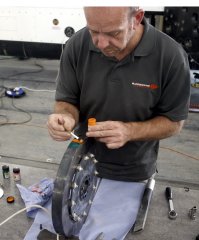
At Newquay we were running carbon carbon brakes front and rear (carbon discs and carbon pads) and saw brake temperatures approaching 1000 deg C – For high speed testing we moved to a metal disk and Ferodo race compound DS3000 pads on the front wheels (nothing on the rear) setting ourselves a maximum brake temperature of 500 deg C, in reality we never achieved this and the peak temperature we saw was 290 deg C when Andy used the wheel brakes at 300mph. This means we could afford to start braking at a higher speed. To manage the temperature when the car came to a halt we used electric blowers in the wheel arches (unlike at Newquay the brakes are fully enclosed), and then a large blower plugged into a port on the nose provide an airflow directly onto the disks.
What did we learn about the braking pressures – what makes the wheels skid?
Two of the sensors we had difficulties with were the front wheel speed sensors, our intent was to look at differential wheel speed to give Andy a skid caption (warning) in the cockpit. Due to noise and a trigger issue with one of the sensors we then looked at using a comparison with wheel rpm vs a predicted rpm from GPS. However, the simplest route was for Andy to ‘feel’ once he had locked the wheels which he did deliberately at low speed on the last couple of runs. We established a braking limit of 45 bar applied pressure during run no. 30 (profile 7, 481mph vmax), which gave a braking deceleration of 0.08g.
We did see some braking performance improvements over a succession of runs and this may have been due to the pre-bedded brakes bedding in further as the run programme progressed; however overall the brakes barely bedded in at all as they were only used in anger about 12 times, evidenced by the lack of surface wear.


