


Bloodhound High Speed Testing
During October/November 2019, the team took Bloodhound to the Kalahari Desert in South Africa to carry out the first high-speed testing programme. The team achieved their target of more than 1000 Km/h (it actually reached an incredible 628mph or 1010Km/h). The data from the test programme conclusively showed that with the planned addition of the rocket motor, Bloodhound can safely achieve speeds of over 800 mph on this beautiful 12-mile dry lake bed in South Africa. We now know, with significant confidence, that Bloodhound LSR is capable of smashing the current World Land Speed Record.
Bloodhound High Speed Documentary
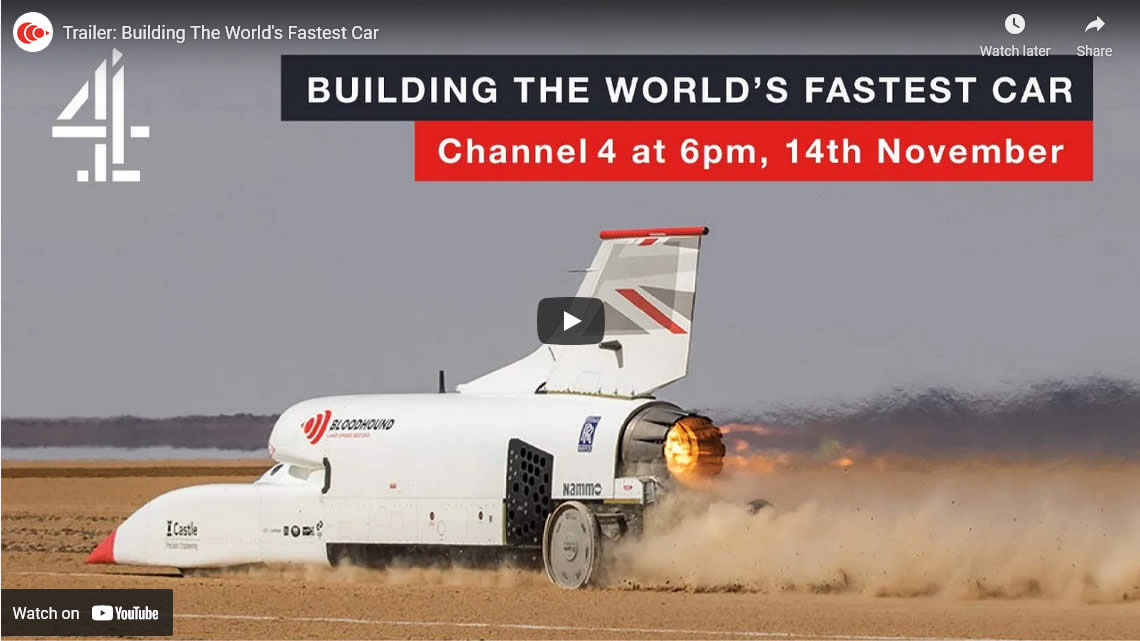
0 to 628mph / 1010kmh in 50 seconds
High speed tests
A vital stage in the road towards a new world land speed record is high speed testing (HST). This follows on from the low speed testing done at Cornwall Airport Newquay in 2017.
During the high speed tests at Hakskeenpan, we ran the car at three times the speed achieved at Newquay (210mph, 338km/h), taking the car up to 628mph (1010km/h). We did this in stages, allowing our engineers to gather a whole range of key data about the car, plus other information needed to plan everything related to the record-breaking runs. This includes how the wheels interact with the desert, validation of the computational fluid dynamics (CFD) models and testing the parachutes.
These high speed test runs were carried out using just the Eurojet EJ200 jet engine, as at Newquay. We also removed the runway wheels used at Newquay and replaced them with the purpose-built solid aluminium alloy wheels.
Setting a new record
After the high speed tests, the car was brought back to the UK. The Nammo rocket needed for the second stage of the run, to boost the car’s speed to a new record-breaking figure, will complete development and be fitted into the car.
Following a delay due to the pandemic and once we have raised the required funding, the Bloodhound LSR team aim to return to South Africa and attempt to set a new Land Speed Record.
And beyond?
After setting the new world land speed record, the team will make a range of assessments before deciding whether to pursue the 1,000mph (1,609km/h) speed that the car has ultimately been designed for. Key among these factors is whether the technical requirements are considered feasible (which we’ll have a clearer view of having actually run the car at supersonic speeds), whether sponsors want to be involved again and, of course, whether it’s considered safe.