
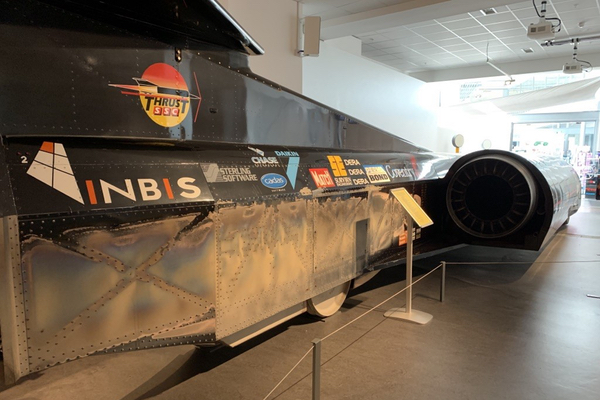
One of the unknowns that we hope to understand better after high speed testing is the amount of abrasion that will be created by the sand on the desert track.
We’ve had a lot of discussion around the topic of abrasion, with many differing views among the engineers on how bad it will be, and therefore the extent of shielding required in the wheel arches.
The only vehicle to have operated at supersonic speeds in a desert environment is Thrust SSC. A few weeks ago our CEO, Ian Warhurst, went to see Thrust SSC in the Coventry Transport Museum and had a very close look to obtain some empirical data! Careful inspection of Thrust SSC revealed that the area behind the aluminium panels is a large open void. A small line of sand remains stuck to the rear of the wheel arches, which must have been blasted there the last time the car did one of its supersonic runs back in 1997. However, there were no obvious signs of abrasion. This has allayed fears among our Engineering team.
In Bloodhound LSR, the wheels have much closer fitting carbon fibre covers. As a result of Ian’s visual inspections of Thrust SSC, the decision was made to use aluminium sacrificial linings on the inner wheel arches for high speed testing (instead of titanium). We think these will be adequate right through to the end goal.


