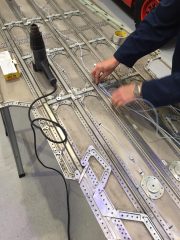
One of the most important parts of the high speed testing will be understanding how the air pressure changes over the surface of the car as it travels through increasing speeds – especially as the car enters the transonic air flow regions. We are looking for any instability in the air flow which is directly related to loads on the car. Ron Ayers, Bloodhound’s Chief Aerodynamicist has worked with the University of Swansea using Computational Fluid dynamics (CFD) to extensively model the air flow to design the final cars shape. It’s now time to find out how accurate these computer models really are. To do this, the surface of the car has been covered in 192 air pressure tappings.
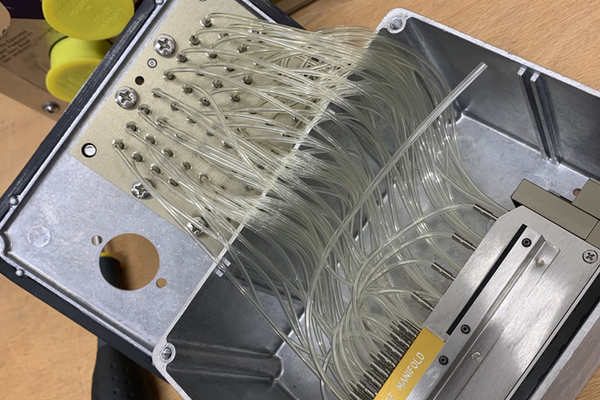
 Each tapping is built through the skin of the car body and has a small hole at the surface. This hole is connected to a plastic pipe which runs back to a manifold. As the air travels over the surface of the car, the air pressure changes in the pipe. The manifold connects all the pipes into a Scanivalve, which converts the pressure into an electronic pressure value. The pressure is measured accurately at 45kHz as the car accelerates so data gathered gives actual pressure values every 0.000022 seconds showing the change over time and speed as the car accelerates.
 This valuable data will then be carefully compared to the original CFD model using a ‘heat map’ to show the size and position of any variations from what is expected. Engineers don’t like surprizes – so if there are any, they will be discussed in detail to determine any required actions! This all helps to ensure the car is safe and stable as it increases speed – which is increased slowly over many runs.
The pressure tappings are concentrated around the areas of the car where we are least sure of the accuracy of the computational models, and also as the car is going in a straight line, the flow should be reasonably symmetrical, so the tappings are not mirrored on both sides of the car, on one side there is a set of tappings looking at flow behind the front wheel arch, but not the other for instance. This makes best use of the limited number of channels we have.