
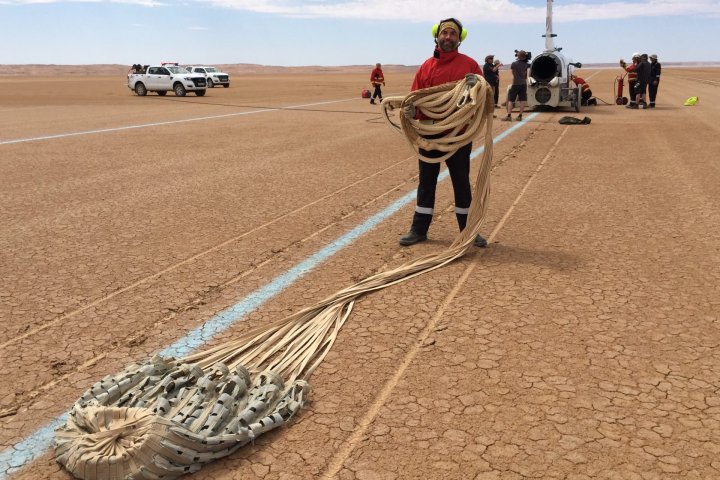
The parachutes used on Bloodhound LSR aren’t like the ones you’d want to tie yourself into if jumping out of an aircraft for a leisurely skydive. Developed originally in the 1960s for retarding projectiles dropped from aircraft at high altitudes the parachutes used on Bloodhound were also used to slow Thrust SSC down. Some of the chutes were still deeply impregnated with Nevada desert.
For the High Speed Trials campaign our partners Survival Equipment Services (SES Ltd.) and Marlow Ropes prepared and serviced 11 parachutes for us to use. Each chute consists of:
- A drogue chute, which is pushed into the airstream by a large coiled spring housed in a partially-aerated nylon bag, connected to a parachute bag containing:
2. The parachute canopy tied into the parachute bag with a breakable strings of known breaking strain (Ventline Tie and Centre Base Tie, or ‘CBT’); the parachute canopy is linked by:
3. Canopy rigging lines, which were methodically bundled above and tied with a ‘larkshead’ knot to:
4. A 32mm 12-strand Nylon main strop, which in turn was tied to:
5. A Technora Weak Link tethered to the car by:
6. 30mm diameter stainless steel pin which transfers loads through the parachute bracket to the car’s chassis.
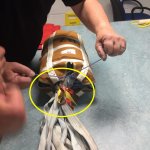
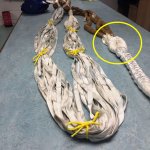
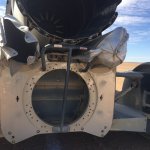
The aluminium cartridges with tightly packed parachutes each weigh around 28kg.

The parachutes are deployed at speeds of between 350mph to 600mph with braking loads of around 4-6 tonnes. The weak link is designed to break against snatch loads of 15,500kg to avoid damaging the car under extreme loads.
The Nylon main strops supplied by Marlow Ropes are designed to allow 25% stretch to reduce the shock loading onto the car; after first use the strops were visibly stiffer but still retained sufficient stretch necessary to absorb the snatch loads onto the car.
Our main challenges with the parachute systems were twofold. Firstly, how to ensure the Centre Base Tie breaks at the right moment; too soon and the canopy would ‘dump’, potentially hitting the ground as it unfurled; or not breaking at all and the canopy would remain in the bag and not doing much to slow the car. You could spend months calculating and predicting what strains should be used and still be wrong; the turbulent environment behind the car is just too difficult to predict for theory to be of any real use. So using the best experience, courtesy of SES and our parachute system advisor, Andy Cowley, was to start with 80lb and go from there. This was good advice: all parachutes deployed, and we ended up settling on 150lb CBTs for this higher speed cases.
The second challenge was how to ensure the parachute sat cleanly behind the car. As we found from the initial parachute test at 350mph the canopy would ‘dance’ around the plume and translate some off-axis loads through the car, causing more work for Andy as he had to counter these with some sharp steering inputs. With Andy’s insight from previous LSR attempts we removed No. 2 and No. 4 ribbons (the rings of material making up the ‘draggy’ parts of the parachute), being careful to maintain the structural integrity of the chutes. Although this would slightly reduce drag performance, and consequently lengthen stopping distance, this completely resolved the ‘dancing’ canopy problem.
The test results showed the predicted performance matched with actual, giving a correlation of 1.7 D/q (aerodynamic drag normalised dynamic pressure) between the pre-test estimate and post-test match using the modified chute configuration.
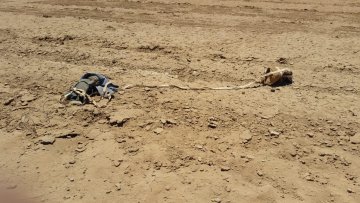 The casualties of parachute deployments were the drogues, which almost never survived to be used for a second run. Despite attempts to reduce the loads on the spring’s retaining bag the forces at play as the drogue is pushed into the turbulent airflow were just too great. Occasionally the forces of the main strop would deform the large teardrop-shaped aluminium parachute cartridges, but unlike the drogues, Marko’s metal (re-)forming skills soon made the aluminium cartridges good for reuse.
The important thing to note about the parachutes is there always remains a risk of a single or even double chute failure, which often afflicted Thrust SSC’s runs. So although Bloodhound’s mechanical chute system is elegantly simple (removing the possibility of squib failures, for example), and despite 100% successful chute deployments our approach remained to plan each run on the premise of a double chute failure. This was key to ensuring Andy’s safety. We did use the data to refine stopping distances predictions which informed where the rescue and recovery teams would be positioned for each run.
So now have the data necessary to accurately predict retardation loads, stopping distances, chute survivability, maximum load paths through the chassis, and a measure of maximum thermal loads on the strop at the exit of the jet nozzle. Looking forwards we’re now able to fit a new parachute bracket mounted further aft with stiffeners between the rear bulkhead, removing the need for a strop whip guard, which protects the petals on the EJ200, and increases accessibility when the rocket is installed. In addition the electric parachute release will be installed so Andy won’t need to take his hands off the steering wheel to deploy each chute, with the manual release as a tested backup.


