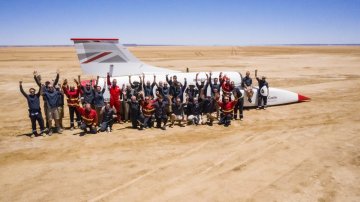
We did it! 628 mph, 1,010 km/h. Bloodhound exceeded all our expectations by blasting past 600 mph and making it look easy.
However, just before we get carried away about how ‘easy’ this sport of straight-line racing is, we did have to work quite hard in November to get this amazing result.
Things started well enough with rapid progress up to 500 mph. As mentioned in last month’s diary, we were also getting on top of a couple of car handling problems. After our initial testing, it became clear that we didn’t want to run the car in crosswinds above 10 mph – fighting the steering at several hundred miles an hour convinced me of that quite quickly. The other key problem we solved was making the brake chutes fly steadily behind the car, rather than oscillating from side to side. This was key to being able to go faster safely. If the car needs to slow down quickly (see below…), the chutes are there to rescue it, so they need to make things better, not worse.
After hitting 501 mph in early November, we were hoping for a couple more quick runs up through 550 mph to 600+, to finish our high speed tests. It wasn’t going to be that easy. At the end of the 501 mph run, the ‘Fire’ caption had come on in the cockpit, indicating an engine bay overheat. Needless to say, I shut the engine down fairly quickly, just in case. Bloodhound’s rescue crews were alongside the car within seconds, confirming that there was no sign of fire.
The heat detection system around the engine uses something called ‘fire wire’, which changes its electrical properties (resistance and capacitance) when it gets hot. However, the electrical properties will also change if the fire wire gets slightly damaged. On close inspection, we found a small ‘kink’ in the wire that could well have set off the warning. The wire was fixed and tested, and we were ready to go again.
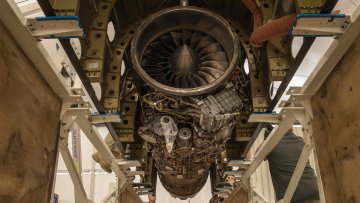
On the next high speed run a couple of days later, the ‘Fire’ caption came on again, accelerating through 470 mph. Within one second I had throttled back the engine, before deploying the brake chute, which flew rock-steady behind the car – this is the time when it needs to be working perfectly! Once again, no signs of fire, so we had to look deeper with a full strip down of the rear end of the car. More fire wire damage was found and sorted. The temperature stickers inside the engine bay also showed local overheating, requiring some simple modifications. This is all part of test-and-development engineering: it’s what this year’s high speed test session was all about.
After these minor interruptions, the car behaved perfectly. Four more runs were needed, 2 with the airbrakes deployed (which work better than expected – good news!) and 2 at high speed to complete the testing.
The final run was meant to hit just over 600 mph, but it didn’t quite work out like that. The calculated distance for the acceleration was just under 4.5 miles (7 km), so ‘Rescue 1’ was positioned at Km 7 to make a radio call as I went past, backing up the in-cockpit distance readout.
As I went blasting past the Km 7 mark, I heard the call from Rescue 1. The car was only doing 580 mph at this point. We had a small safety margin to play with, so I counted another 2 seconds, hit 600 mph and then throttled back. The engine took a fraction of a second longer than usual to wind down: Rolls-Royce had warned us it might do this at high speeds. Despite this, I only saw a peak speed of 608 mph in the cockpit. All good so far.
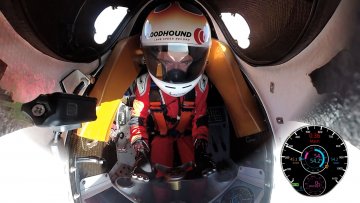
In fact, up to this point, the run had been pretty much perfect. You can see a compilation of the onboard footage in the video of our final run. To give you some idea of what I’m doing, here’s a breakdown of the run in 10-second chunks:
- Zero seconds. RAF air traffic controller Jess Kinsman’s voice breaks through the noise of the jet engine: ‘Bloodhound, Control, Clear to Roll, Wind is Southerly 3 gusting 6 mph’. Brakes off, right foot pushing the throttle pedal forward to the detent for max. dry power. A small tweak of steering to straighten the car up, already doing 30 mph, check the engine is at max. dry, select max. reheat which lights almost immediately. The car is already doing 100 mph.
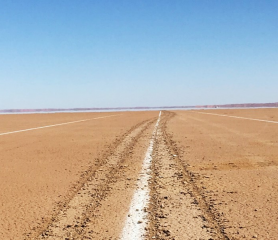
- 10 seconds – 120 mph. The car is accelerating at full power, adding another 20 mph to the speed every second. The power from the EJ200 jet engine is just awesome. At just over half a mile from the start, the car hits the filled-in ruts of the ‘old’ road across the Pan, already doing 180 mph. The suspension soaks up the bump, the only one I’ll feel during the whole run thanks to the amazing work of the local population in preparing the world’s best high speed race track.
- 20 seconds – 290 mph. Above 200 mph, the car starts to slide around more and more, as the high speed metal wheels begin to ‘plane’ over the hard mud surface. The light winds are enough to push the car around (you can see the movement in the video).
- 30 seconds – 440 mph. I’m still working at the steering to keep the car straight. On the audio you can hear me reminding myself to go ‘Easy on the steering’ so I don’t risk making it worse. The car drifts right a little, as I let it yaw gently into the wind. 3 miles into the run, the car crosses the old ‘causeway’ road at 500 mph, with barely a blip of movement through the chassis.
- 40 seconds – 550 mph. As the drag builds up, the acceleration slows down a little, but we’re still putting on 10 mph every second. I’m punching in steering inputs of up to 30 degrees each way, with much quicker movements needed at the higher speeds. The car gets to Km 7 showing 580 mph in the cockpit. I count another 2 seconds.
-
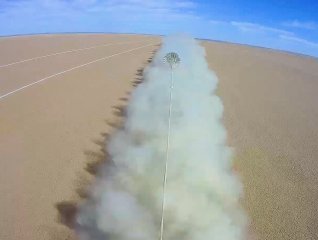
Good chute! 50 seconds – 600 mph. The moment the needle touches the ‘6’ mark, I throttle back. The engine lag is noticeable. In my head I’m already running through the first steps of the emergency shutdown drill, just in case, when it starts to wind down less than one second later. As soon as the car settles at idle thrust, I reach down with my left hand to pull the lever for Chute 1. A short pause, then a ‘thump’ as the chute hits us with an extra 6 tonnes of drag. The speed falls off very quickly now: losing 100 mph takes less than 4 seconds.
- 60 seconds – 420 mph. One minute after releasing the brakes, the car is slowing down through 400 mph. The steering is settling down, helped by the rock-steady performance of the brake chute, and I can follow the line very accurately from now on. The end of our 10-mile race track is now less than 3 miles away, but we’ll stop with plenty of distance to spare.
- 70 seconds – 280 mph. As the car slows down to 250 mph, I get ready to ease the wheel brakes on with my left foot. Applying exactly 45 Bar of hydraulic pressure (that’s a fairly firm press on the brake pedal) will give us optimum brake performance. Let’s not forget that we’re still doing 250 mph though, in a 6-tonne car, so it’s going to take about 25 seconds to stop after I put the brakes on.
- 80 seconds – 180 mph. Not much left to say. After driving at over 600 mph, it feels like I can get out and walk at this point…
After the car stopped, the data showed a peak speed of 628 mph, about 20 mph faster than I thought (and of course over 20 mph faster than I was aiming for). If I look a little perplexed in the video of the run, then that’s why. I assumed that the slightly slow engine wind-down had caused at least some of this difference, but a full 20 mph? That’s over 2 seconds of full-power acceleration at 600 mph. I couldn’t understand it.
A longer look at the data after we got back to our Tech Camp, plus reviewing the cockpit video frame-by-frame, gave me the answer. The GPS speedo had ‘jumped’ by 20 mph during the run, as one of the 3 onboard GPS feeds gave a poor signal (this is one of the reasons why the Land Speed Record is measured with external timing lights and not onboard GPS). It’s an unusual fault, but an easy one to fix with a software filter. Another ‘win’ for the high speed testing.
Despite the small GPS glitch on the last run, the end result was a fabulous one. We went out to South Africa hoping to get the car over 600 mph and, if there was enough performance left, to touch 1,000 km/h if we could. 628 mph, our peak speed, equates to 1,010 km/h – job done! A perfect end to a great high speed test session. As our Operations Director Stuart Edmondson says in the same video, ‘This car is absolutely ready for Land Speed Record speeds!’. Quite so.